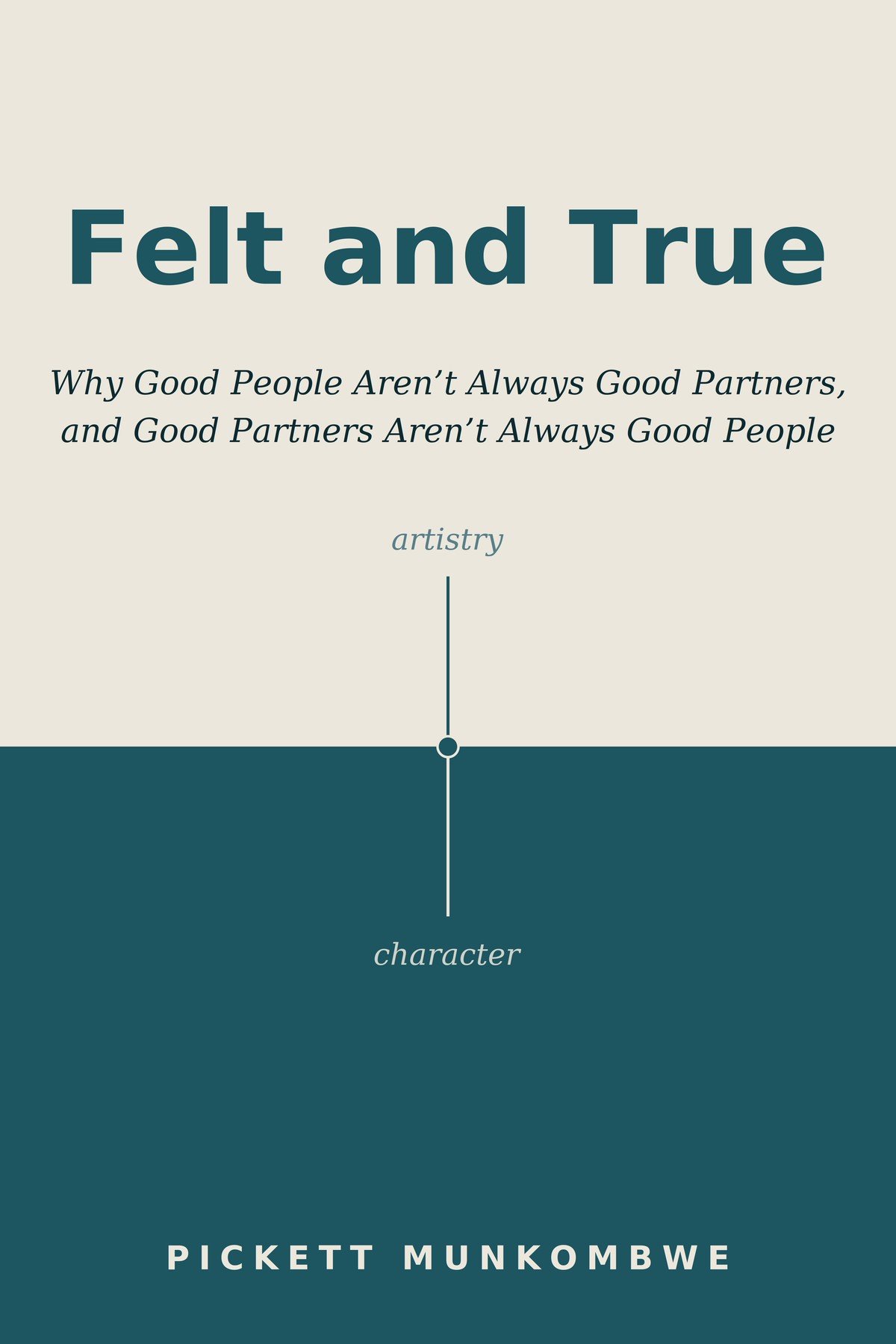
Why good people aren't always good partners, and good partners aren't always good people.
Author
Pickett Munkombwe
Length
74 pages · approximately 24,000 words
Published
April 2026 · Lusaka, Zambia
Format
Full PDF · delivered by email
About the book
Two axes, not one.
Most of us make two judgements about a partner at once and rarely pull them apart. One is about character: is this a good person? Will they behave well when the conditions get harder? The other is about partnership as a practice: do I feel met by them? Does their love reach me? When the two judgements align, we stop noticing that they are two judgements. When they diverge, we notice, and we do not know what to do with the noticing.
Felt and True offers a vocabulary for that noticing. Character is who a person is when the conditions get harder. Artistry is how that care reaches the other person in the daily texture of life together. Neither axis is decorative. Neither substitutes for the other. A large gap between them, in either direction, is not a trade-off to accept. It is a signal to read.
The two axes of a partnership
Written from Lusaka and drawing equally on relationship research and the kin-embedded traditions of Zambian partnership — banachimbusa, alangizi, chilanga mulilo — the book places its argument inside two frames rather than one. Much of the relationship canon is written for a dyadic world. That is not the only world. Holding both frames at once reveals what either alone conceals.
You will not find a scoring quiz here, or a six-week recovery plan. What you will find is a clearer eye. The ability to look at your own relationship and see which axis is thriving, which is thin, and what kind of work each one asks for. Three realist interludes, set in Lusaka, the Copperbelt, and Livingstone, show the failure modes and the repair mode in lived texture.
Read before you buy
Two chapters, reproduced in full.
Rather than a curated excerpt, the book is best sampled through two of its chapters read whole. Each stands on its own. Each shows a different register of what the book does.
Chapter 3
A Zambian Frame
The pivot chapter. Opens on a post-wedding visit to a Bemba aunt's compound on the Copperbelt, and from there places the two-axis model inside the kin-embedded traditions of Zambian marital teaching. Argues that the distinction between character and artistry has always been inside those traditions, under different names.
The second failure mode, written in full. The partnership in which character is abundant and artistry is thin. The quiet loneliness of being loved by a good person whose love does not quite reach you. Includes a plainly written passage on the sexual dimension of the pattern, rare in the literature.
A direct, human transaction between a reader and a writer. Send payment through mobile money, and the book will be emailed to you within 24 hours.
ZMW 120
Full PDF · delivered by email within 24 hours
MTN MoMo+260 76 122 8664
Airtel Money+260 97 921 2282
Send ZMW 120 to either number above.
Email your payment confirmation to pickett1312@gmail.com, with the email address where you would like the book sent.
You will receive the full PDF within 24 hours.
Felt and True was developed through an extended collaboration between the author and an AI writing system. The conceptual framing, Zambian grounding, chapter structure, and editorial direction at every stage are the author's. The sentences themselves were largely produced by the AI under that direction. Disclosed here, because readers have a right to know how a book was produced.